

Rescue at sea
Relieved Vendée Globe skipper Kevin Escoffier speaks about his dramatic rescue for the first time.
02 December 2020

Advertisement
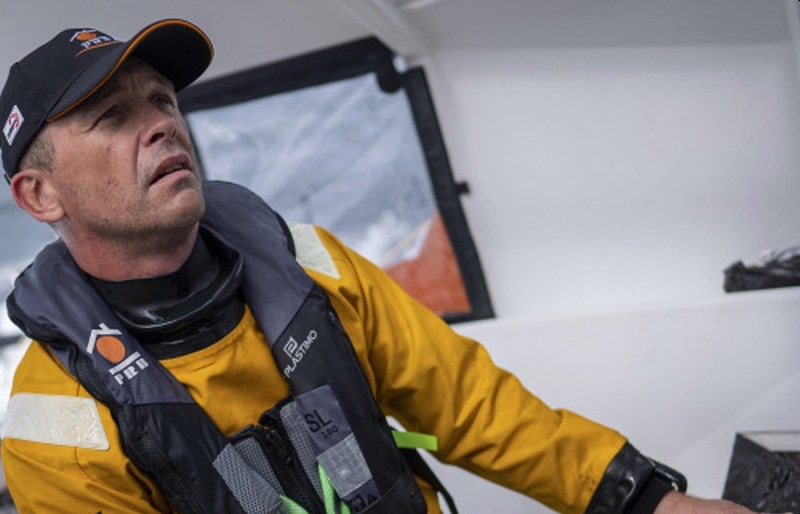
After being rescued from his life raft by fellow Vendée Globe competitor Jean Le Cam in big seas and strong winds in the early hours of this morning some 840 nautical miles south-west of Cape Town, South Africa, Kevin Escoffier has been recovering on board Le Cam’s appropriately named IMOCA 60 Yes We Cam!
The 40-year-old solo sailor had to abandon his IMOCA 60 PRB within what he later estimated to be two minutes when his boat virtually broke in two after burying its nose in a wave while racing in 5-metre waves and 25-knot south-westerly winds.
Escoffier only had time to grab his survival suit before being washed off the boat, clambering into his liferaft that automatically inflated.
Veteran 61-year-old Jean Le Cam, racing on his fifth Vendée Globe, answered the request of Race Direction to divert and try to pick up Escoffier, whose boat’s emergency beacon had been activated at 1346 hrs UTC.
Advertisement
When he arrived in the area some two hours later, he located Escoffier in his life raft but was unable to manoeuvre and prepare properly to effect a rescue on time before losing sight of the life raft in the big seas, strong winds and growing darkness.
Race Direction in Les Sables d’Olonne diverted three other skippers, Germany’s Boris Herrmann (Seaexplorer-Yacht Club de Monaco), Yannick Bestaven (Maître CoQ IV) and Sébastien Simon (ARKEA PAPREC) and drew up a search protocol using Meteo France’s MOTHY drift prediction program, engaging the three solo skippers in a triangle search pattern. They had intermittent distress beacon signals that appeared to follow no pattern.
But it was only when he was directed close to a locator beacon position – which coordinated with the predicted drift pattern – that Le Cam spotted a reflected beam of light bouncing off a wave and realised he had finally located Escoffier again.
He plucked him from the life raft at 0118 hrs UTC this morning.
It was only when the two suddenly appeared together on a Skype video call – which had been running constantly from Le Cam’s boat to a monitor in the Les Sables d’Olonne HQ – that Race Direction suddenly realised the mission had been successful. Escoffier had been rescued.
A world-renowned ocean racer may have been on only his second ever solo IMOCA race, but Escoffier won the crewed Volvo Ocean Race in 2018 on the Dongfeng team and was part of a successful Trophée Jules Verne around the world in 2012. He was key technical director of the Armel Le Cléac’h Vendée Globe winning program on the 2016–17 race.
Smiling and relieved, he spoke to the Vendée Globe English Live from on board Le Cam’s Yes We Cam!, saying “I’m doing pretty well. Much better than last night, which I spent in a very bad bed and breakfast.”
“It’s still hard for me to believe it; I broke the boat inside the wave at 90 degrees. I should have taken a picture so people could believe me.
“Just after the wave, the bow was pointing at 90 degrees from the stern of the boat, and all the water was coming forward. The water level inside rose very fast and I had a very short time to decide what to do.
“I’ve been thinking about when I got on the life raft and if I should have waited. But it’s done. Should I have tried to stay a bit longer on the boat? It might have been easier for people to find me, but I’m pretty sure I wouldn’t have been able to stay the night on the boat – the water, which was already above the deck level, was too dangerous. I was better in the life raft.”
“It’s unbelievable what happened. The boat folded up on a wave at 27 knots. I heard a bang, but to be honest, I didn’t need to hear that to know what had happened. I looked at the bow. It was at 90 degrees.
“In a few seconds, there was water everywhere. The stern was underwater and the bow was pointing up to the sky. The boat split in half in front of the mast bulkhead. It was as if she folded up. I promise I’m not exaggerating.
“There was an angle of 90 degrees between the stern and the bow.”
“I didn’t have time to do anything. I just had time to send a message to my team. I’m sinking. I’m not joking. MAYDAY. Between the moment when I was out on deck trimming the sails and when I found myself in my survival suit, barely two minutes had passed. It all happened extremely quickly.
“I came out of the boat and put on my survival suit. I could see smoke. The electronics were burning. Everything went off. My only reflex was to grab my telephone to send the message and pick up the survival suit, which I never stow away.
“I wanted to pick up the grab bag, but I couldn’t get to it with the water rising. I grabbed the life raft at the stern but couldn’t get into it as it was 3 metres under the water. The water was up to the door in the cockpit.”
He continued, “I was going to stay the whole night in the life raft, that’s what I was thinking. It was okay for me, it was safer to switch from one to the other with less wind and less waves.
“I spent the night quite well. I mean, I wasn’t comfortable, but in my head, it was better. I was sure that someone would be coming the day after when there were less winds and fewer waves, and then I’d be able to get from the life raft to the boat. I had a bit of trouble sleeping during the night. I’d eaten a bit and was drinking the water I had on board.
“Close to morning, I heard a sail flapping so I got my head out of the life raft and saw, because of the moon, it wasn’t dark any more. Even with no sun, we were able to see very well and I saw Jean at 100–200 metres from me.
“I asked him, ‘Now, we’re doing it now?’ and he said, ‘Yes, let’s do it now. I will come against you.’ He wanted to have his boat parallel to the life raft but he was a bit too fast and it was 5 metres away, I don’t know exactly. He threw me a line with a buoy at the end, which I caught, and both of us pulled it to get the life raft as close as possible to his boat. When I was close enough, I jumped and caught the back of the boat.
“He said, ‘Are you on board? Are you on board, Kevin!’ He was very happy. I said, ‘Yes I’m on. I’m sorry to disturb your race, Jean.’ We had a big hug.”
Race direction has discussed a plan to evacuate Escoffier to the French navy’s Nivôse – a Floréal-class frigate – at the Kerguelen Islands, but this has yet to be confirmed by authorities.
Meanwhile, the International Jury will convene in the next few days to discuss time compensations for the skippers whose races were put in parenthesis while they were engaged in the rescue mission. This process takes into account not only the actual time lost when the sailors were away from their race route, but also any significant changes in their racing conditions – wind and routing – caused by the delay.
Charlie Dalin continues to lead the race by 218 miles from Thomas Ruyant (LinkedOut), who crossed the longitude of the Cape of Good Hope at 1341 hrs UTC. He was 14 hours and 30 minutes after Dalin’s passage last night. Louis Burton – who is Escoffier’s cousin by marriage – now lies third on Bureau Vallée 2.
-
Advertisement
-

Advertisement
-

Advertisement
